IFR flight
The Rules
The main differences between VFR and IFR flight are summoned up below.
1. Separation and clearance
Different rules apply when flying by VFR rules or IFR, with regard to separation, or collision avoidance.
Basically under VFR you are responsible for not flying into other aircraft or obstacles.
In IFR, which used to be called blind flying (!), and especially in IMC or very busy airspace this responsibility, apart from your own responsibility to your and your passengers safety (!!), lies with ATC (Air Traffic Control).
2. Weather
Obviously it is hard to see and avoid when flying in IMC.
The VFR rules are:
- you need VMC !
- you cannot fly through clouds
- you must have more than 8km visibility
- you must keep a safe distance from any object (including clouds..)
These rules do not apply to IFR.
3. Navigation
IFR is not always the shortest route between two points.
IFR is always in controlled airspace and requires
- a flight plan: all IFR plans go through Eurocontrols Central Flow Management Unit (CFMU),
- you keep assigned and minimum altitudes; e.g. over mountainous terrain IFR minimum altitudes are twice those of VFR altitudes,
- follow your routing by established waypoints and airways.
5. Procedures
Besides the obligatory Routing, as described above different safety rules and margins are established for IFR flights. For fuel reserves for instance.
Fuel requirements
The regulations regarding fuel depend on a variety of circumstances as well as airplane performance and types. Piston engine aircraft will have different requirements than turbine powered aircraft.
As a rule of thumb we need the following fuel amount, calculated in time (in hrs:min')!
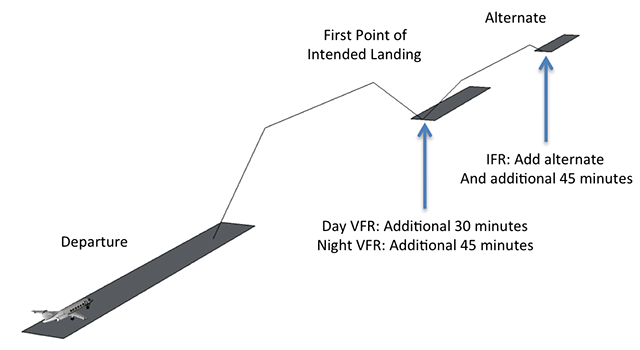
| FLY FROM | TO | time | example |
|---|---|---|---|
| Departure | Destination | trip time (ETE) | 0:58' |
| Destination | Missed Approach | appx. | 0:10' |
| Destination | Alternate airport | ETE | 0:22' |
| Holding | 0:45' | ||
| TOTAL | 02:15' |
IFR flights are conducted in controlled airspace.
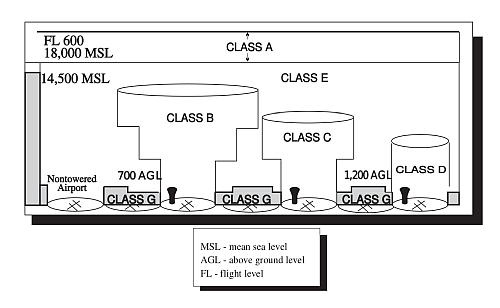
An elaborate system of controlled airspace exists. This is beyond the scope of this guide, but if you are interested: wikipedia.
Before entering any controlled airspace your have to be cleared into that airspace by ATC.
ATC wants to know who and where you are. That is why a Transponder is mandatory! Your transponder sends additional information along with the primary radar echo. This information may consist of only your identification code (mode A) or your altitude in flight levels (mode C) in addition to your identification. Nowadays mode S is in use, where ATC can obtain extra information, like aircraft type, destination and the like. If your aircraft is not equipped with mode S, at least use mode C. This will have to be mentioned in your flightplan.
When you receive any clearance, you have to acknowledge this by reading it back.
The clearance scheme, used by ATC, can be easily remembered using the acronym "CRAFT" Clearance Limit - Route - Altitudes - Frequencies - Transponder (Squawk) code
6. Qualifications
- Pilot
The pilot must be qualified, meaning he or she must have the required skills as well as the required IFR ratings. - Aircraft
The aircraft must be IFR equipped and certified. The required equipment is stated in the aircrafts Minimum Equipment List (MEL).
Flying in IMC: Attitude is everything!
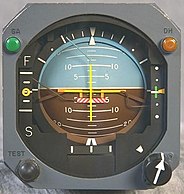
This expression refers to the primary flight instrument, that offers you a window outside in IMC. The Attitude Indicator, also called the Artificial Horizon, or if it is combined with a Flight Director: the ADI (Attitude Drection Indicator) is your first instrument to consult if you experience vertigo or other disorientation! Instrument Flying is an important skill to acquire, but learning it is beyond this written guide.
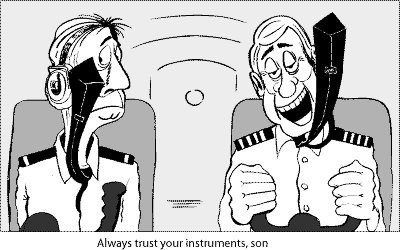
For preparing IFR flights a short checklist:
prior to flight / filing checklist:
- [ ] flight plan
- [ ] wx conditions destination
- [ ] alternate requirements
- [ ] wx conditions departure
- [ ] routing
- [ ] fuel requirements
- [ ] range
- [ ] econ
- [ ] cruising altitudes
- [ ] aircraft certification
- [ ] airworthiness
- [ ] flight instrumentation
- [ ] pilot / crew certification
| <- back | next -> | |
|---|---|---|